
sopping
Supermarket: How It Shapes the Way We Shop and Eat

Introduction: More Than Just a Place to Buy Groceries
Walk into any supermarket on a Tuesday afternoon, and you will find something quietly remarkable. Thousands of products are arranged under one roof. Produce flown in from three continents. Ready meals, specialty cheeses, organic grains, and birthday cakes are all available within a few hundred square meters. Background music plays at a carefully chosen tempo. The lighting is tuned to make the vegetables look fresher. Nothing about the experience is accidental.
The supermarket is one of the most successful commercial inventions of the modern age. Yet, most of us move through it on autopilot, list in hand, barely registering the sophistication of the system surrounding us. Understanding how supermarkets came to be, how they work, and where they are headed tells us a great deal about economics, culture, food systems, and the everyday rhythms of contemporary life.
A Brief History: From Corner Shop to Cathedral of Consumption
For most of human history, buying food meant visiting multiple specialists. You went to the butcher for meat, the baker for bread, the greengrocer for vegetables, and the fishmonger for fish. Each shop was small, personal, and limited in its range. Shopping was a social activity, often involving conversation, negotiation, and a relationship built over years.
That model began to change in the United States in the early 20th century. The credit for the first true supermarket is widely given to Michael Cullen, who opened King Kullen in Jamaica, New York, in 1930. Cullen’s innovation was combining a wide variety of food products under one roof, selling at low margins and high volume, and allowing customers to select items themselves rather than asking a shop assistant to retrieve them. Self-service was the key breakthrough. It reduced labor costs dramatically and gave customers a sense of agency and abundance.
The idea spread quickly. By the 1950s, supermarkets were reshaping American suburbs, and the model was being exported to Europe, Australia, and beyond. The rise of the automobile made it practical to build large stores with generous parking lots on the outskirts of towns, and the postwar consumer boom created exactly the kind of aspirational, convenience-hungry middle class that supermarkets were designed to serve.
In the United Kingdom, companies like Tesco, Sainsbury’s, and later Asda built retail empires on the supermarket model. In France, the hypermarket format took things even further, combining grocery shopping with clothing, electronics, and household goods in stores so large they had their own internal road systems. The supermarket had evolved into something closer to a total retail environment.
The Architecture of Temptation: How Supermarkets Are Designed
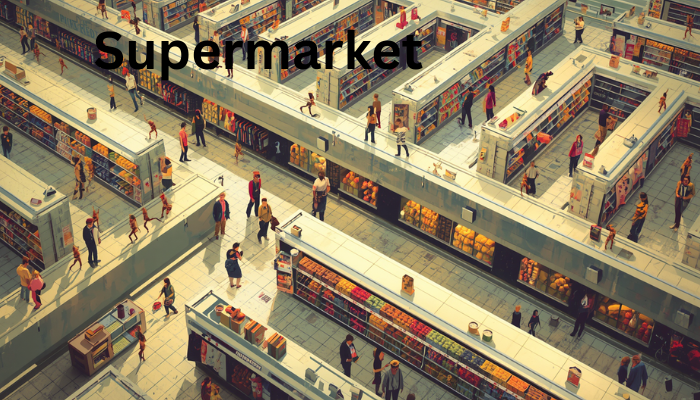
There is a science to the supermarket layout, and retailers have spent decades refining it. Every element of the shopping environment is designed with a specific behavioral goal in mind.
The entrance experience matters enormously. Most supermarkets place fresh produce near the entrance, not because it is the most frequently purchased category, but because the colors, textures, and natural abundance of fruits and vegetables create a positive first impression. Fresh food signals quality and primes shoppers to feel good about their choices before they have made any.
The famous practice of placing essential staples like milk, eggs, and bread at the back of the store forces shoppers to walk through as much of the shop as possible to reach them. Along the way, they encounter products they had not planned to buy. This is not an accident. It is a deliberate strategy to maximize what retail professionals call basket size, the total value of what a customer ends up purchasing.
Eye-level shelving is premium real estate. Products placed at eye level sell significantly better than those placed at floor level or on the highest shelves. This is why brands pay substantial slotting fees for favorable shelf positioning. The supermarket is not merely a place to sell food; it is a marketplace within a marketplace, where suppliers compete fiercely for the most visible space.
Music, lighting, temperature, and even aroma are all carefully managed. Studies have shown that slower music encourages shoppers to browse longer and spend more. Bakery smells piped through ventilation systems stimulate hunger and impulse purchases. The cool temperature of fresh produce sections and the warm glow of the deli counter are not accidental aesthetic choices but calibrated sensory cues.
Supply Chains and the Global Food System
Behind the supermarket shelf lies one of the most complex logistical networks ever created. A typical supermarket stocks between 20,000 and 50,000 distinct products, and maintaining that range requires an intricate, globally connected supply chain that operates around the clock.
Fresh produce offers a vivid example. The green beans in a British supermarket may have been grown in Kenya, harvested by hand, sorted and packed in a warehouse near Nairobi, flown overnight to a distribution hub in the Netherlands, driven by refrigerated truck to a regional warehouse in England, and then delivered to your local store, all within four days of leaving the soil. The coordination required to make this happen reliably, at scale, and at a price point low enough to compete with other products is genuinely astonishing.
This global reach has transformed what we eat and when we eat it. Seasonal eating, once simply a fact of life, has become a lifestyle choice. Strawberries in December and asparagus in winter are now entirely normal. The boundaries between growing seasons and regional specialties have softened considerably for anyone with access to a well-stocked supermarket.
But this system comes with high costs. Long supply chains generate substantial carbon emissions. The refrigeration required to keep fresh food safe across international distances is energy-intensive. The competitive pressure that supermarkets exert on their suppliers can drive down prices to the point where farmers, particularly smallholders in developing countries, struggle to earn a living wage.
These tensions have made supermarket supply chains a focus of growing scrutiny from environmental groups, labor advocates, and policymakers. The supermarket sits at the center of much larger debates about sustainability, food security, and the ethics of global trade.
Pricing Strategies and the Psychology of Value
Supermarkets are masters of the perception of value. Their pricing strategies are as carefully considered as their store layouts, and understanding them helps explain why we so often spend more than we intended.
Loss leaders are products sold at or below cost specifically to attract shoppers into the store. A supermarket might sell a well-known brand of butter at a price that barely covers its own cost, knowing that once customers are through the door, they will fill their trolleys with higher-margin items. The loss on the butter is an investment in footfall.
Promotional mechanics like “buy two, get one free” or “three for the price of two” encourage customers to buy more than they need. These deals genuinely offer value in many cases, but they also generate waste when shoppers buy more perishable food than they can consume before it spoils. Research consistently shows that multi-buy promotions are a significant driver of household food waste.
Supermarket own-label or private-label products represent another layer of pricing strategy. These products, carrying the supermarket’s own brand rather than a manufacturer’s name, are typically priced lower than branded equivalents and often carry higher profit margins for the retailer. In recent years, the quality of own-label ranges has improved considerably, and many shoppers now choose them deliberately as a quality-conscious preference rather than merely as a budget option.
Dynamic pricing, already common in sectors such as airlines and hotels, is beginning to enter the supermarket industry. Digital price labels and AI-driven systems can, in theory, adjust prices in real time based on stock levels, time of day, and demand patterns. This raises interesting possibilities for reducing food waste by discounting products that are close to their sell-by date, though it also raises questions about fairness and price transparency.
Supermarkets and Food Culture
The supermarket has shaped not just where we shop but what we cook, how we eat, and how we think about food. Its influence on food culture is pervasive and, depending on your perspective, both enriching and impoverishing.
On the positive side, the supermarket has democratized access to a remarkable diversity of foods. Ingredients that once required a specialist ethnic grocer or a trip to a farmers market are now routinely available on supermarket shelves. Miso paste, tahini, harissa, smoked paprika, coconut aminos: the modern supermarket stocks a pantry that would have astonished a shopper from fifty years ago. This has contributed to a genuine broadening of home cooking across many countries.
At the same time, critics point out that the supermarket model has significantly narrowed agricultural diversity. Because supermarkets require consistent appearance, size, and shelf life from their produce suppliers, only a small number of varieties of any given fruit or vegetable make commercial sense to grow at scale. Of the thousands of apple varieties, a typical supermarket stocks perhaps a dozen. The rest have dwindled to the point of near-extinction in commercial terms.
The supermarket has also accelerated the pace at which convenience foods have displaced home cooking. Ready meals, pre-chopped vegetables, single-serve packaging, and grab-and-go options cater to time-pressed consumers and generate substantial revenue. They have also reshaped nutritional habits, which public health researchers continue to study and debate.
The Rise of Online Grocery Shopping
The digital revolution has been slower to transform grocery retail than many other sectors, largely because food shopping involves sensory judgments, immediate needs, and highly perishable products that complicate the online fulfillment model. But that transformation is now well underway.
Online grocery shopping surged dramatically during the COVID-19 pandemic as lockdowns made physical retail difficult or impossible. Many shoppers who had previously been reluctant to buy food online discovered that it was more convenient than they had expected. A significant proportion of them have continued shopping online, at least in part, even as restrictions have lifted.
The major supermarket chains have invested heavily in their online operations, building automated warehouse facilities, developing last-mile delivery networks, and refining the digital shopping experience to reduce friction and increase repeat purchases. New entrants, including rapid grocery delivery services that promise delivery within ten to thirty minutes, have added competitive pressure and forced established retailers to accelerate their digital strategies.
The shift to online grocery shopping has significant implications for store design, staffing, and urban planning. If a growing share of grocery spending moves online, the role of the physical supermarket will evolve. Some analysts predict that large out-of-town supermarkets will increasingly function as fulfillment hubs as much as retail destinations. At the same time, smaller, more experiential neighborhood stores will serve the customers who still want to browse, discover, and touch before they buy.
Sustainability and the Supermarket of the Future
Sustainability has moved from the margins to the center of supermarket strategy over the past decade, driven by consumer pressure, regulatory requirements, and a genuine recognition within the industry that the current food system faces serious environmental limits.
Major chains have set ambitious targets to reduce plastic packaging, cut food waste, lower their carbon footprint, and source products more responsibly. Progress has been uneven, and the gap between public commitments and actual performance remains a legitimate source of criticism. But the direction of travel is clear, and companies that fail to meet rising sustainability expectations face real commercial and reputational risks.
Plant-based foods represent one of the most significant growth areas in supermarket ranges, driven by both environmental concerns and evolving consumer preferences. The availability and quality of plant-based alternatives to meat, dairy, and eggs have expanded enormously, and supermarkets have played a central role in bringing these products to a mass audience by giving them prominent shelf space and competitive pricing.



Supermarket: How It Shapes the Way We Shop and Eat

Heidegger: Philosophy, Being, and the Question That Changed Everything

Cumhuriyet: The Enduring Power of Republican Governance
-

 Fashion9 years ago
These ’90s fashion trends are making a comeback in 2017
-
Entertainment9 years ago
The final 6 ‘Game of Thrones’ episodes might feel like a full season
-
Fashion9 years ago
According to Dior Couture, this taboo fashion accessory is back
-
Entertainment9 years ago
The old and New Edition cast comes together to perform
-
Sports9 years ago
Phillies’ Aaron Altherr makes mind-boggling barehanded play
-
Business9 years ago
Uber and Lyft are finally available in all of New York State
-
Entertainment9 years ago
Disney’s live-action Aladdin finally finds its stars
-
Sports9 years ago
Steph Curry finally got the contract he deserves from the Warriors